How to create a chart from survey results
In this guide, we walk you through how to prepare your survey data & choose the perfect visuals to model your survey results

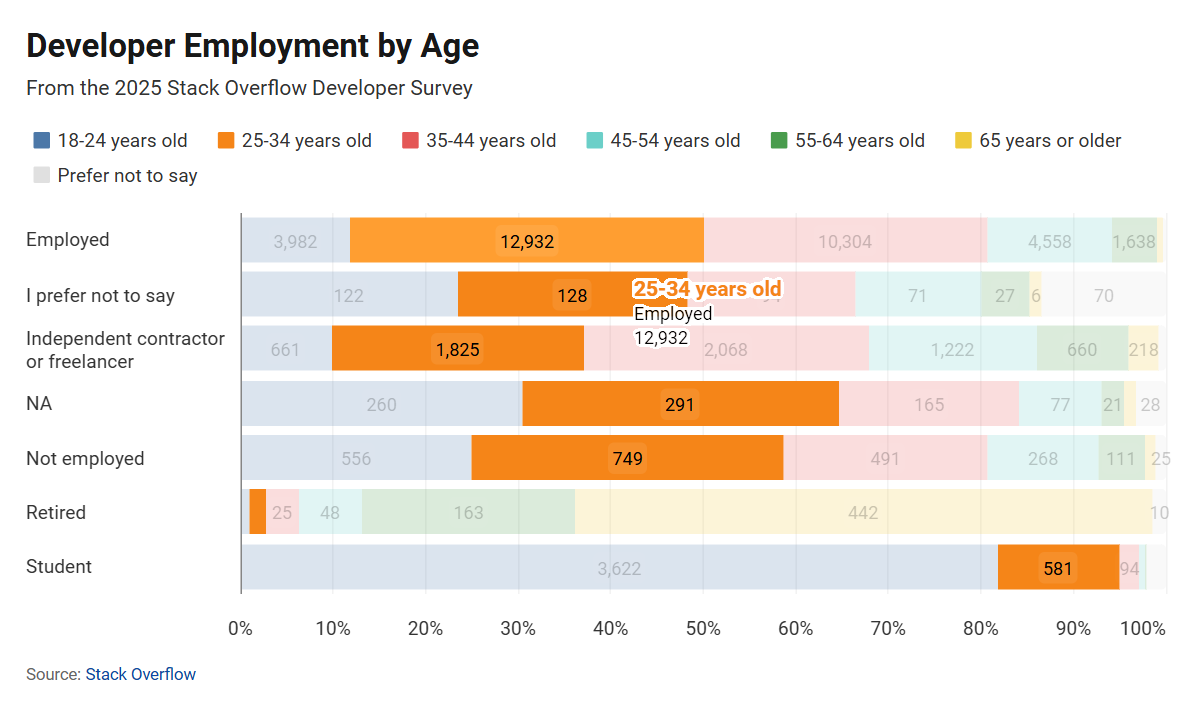
Quickly visualize survey data
Once a survey closes, the responses arrive as a large spreadsheet, and a column full of “Strongly Agree” entries is hard to present clearly at a board meeting. Visualizing the results makes the underlying insights easier to see.
Here is your step-by-step guide to transforming survey results into professional visuals using InstaCharts: the online chart maker.
TLDR: Try the demo or sign up for a free account!
Prepare Your Data for Importing
Before you jump into the tool, ensure your data is “clean.” Most survey platforms (like Google Forms, SurveyMonkey, or Typeform) allow you to export your results as a CSV or Excel file.
Clean your headers: Ensure the top row contains clear questions or category names.
Remove “Incomplete” responses: If a respondent dropped out halfway, their empty cells might skew your averages.
Format Likert Scales: If you used a 1-5 scale, ensure the data is consistent (all numbers or all text).
Login to InstaCharts
Login to your InstaCharts account (if you plan on sharing your data and interactive chart with others or loading your data from Google Drive /Google Sheets).
Or use the demo to try InstaCharts without signing up.
Load your survey data
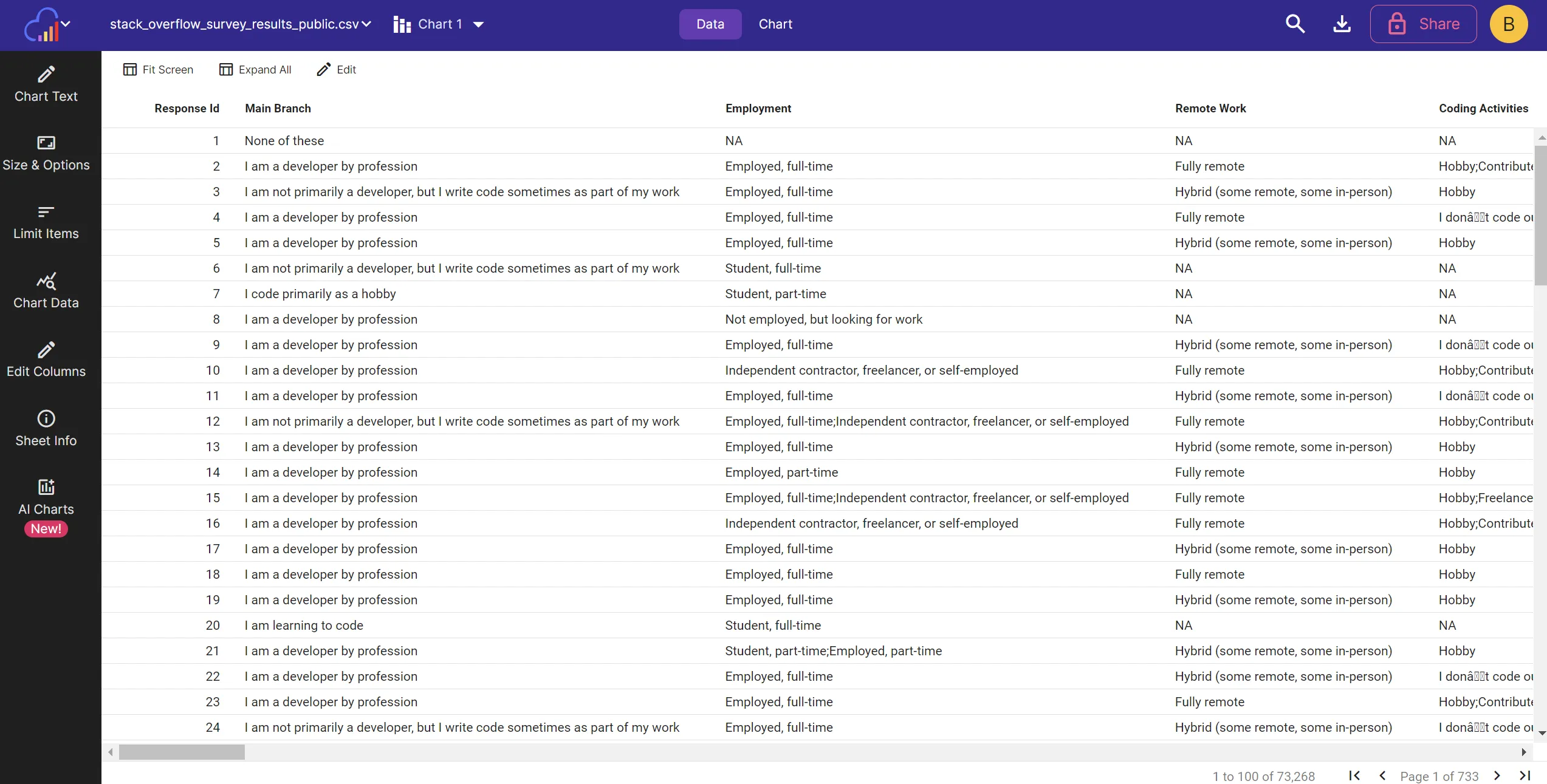 View data in a data table for easy filtering, editing and sorting. Our example chart summarizes all 49k rows of the Stack Overflow 2025 Dev Survey
From your workspace, click New, then New Sheet. There are several ways to import your data:
- Upload a file Load a CSV, excel file, and many more file types using this option. Guide to importing files
- Connect a data source Load a file from Google Drive using this option. Guide to import files from Google Drive
- Blank Sheet Manually type in your data or paste it from another spreadsheet.
Import Options
Big surveys can contain hundreds of columns. To cut down on noise, turn on Choose columns to import and only import the columns you are interested in charting. The preview shows the first 100 rows, with each column header color coded by the type InstaCharts detected: green for dates, blue for numbers, and pink for text.
Free accounts can import up to 500 rows per sheet, Starter accounts up to 25,000 rows, and Pro accounts up to 100,000 rows. Larger survey exports need a plan with enough rows, or a trimmed export.
Import
Once you are happy with how the imported data looks, click Import to import your data into InstaCharts. Next to the Import button, the Generate AI charts checkbox builds three recommended charts from your survey as soon as the import finishes, which uses 1 AI credit.
Refine and Customize Your Charts
That’s it! Once your data is imported into InstaCharts, a new sheet is opened and populated with your data; your first chart is automatically created and displayed.
There’s 2 main tabs on the Sheet page, Data and Chart.
- Use the Data tab to filter and edit data shown in the chart.
- Use the Chart tab to customize the current chart or add more charts to the sheet.
From the Chart tab, you can pick a different chart type and which columns are plotted using the main dropdowns in the chart toolbar. You can further customize the current chart using the left sidebar.
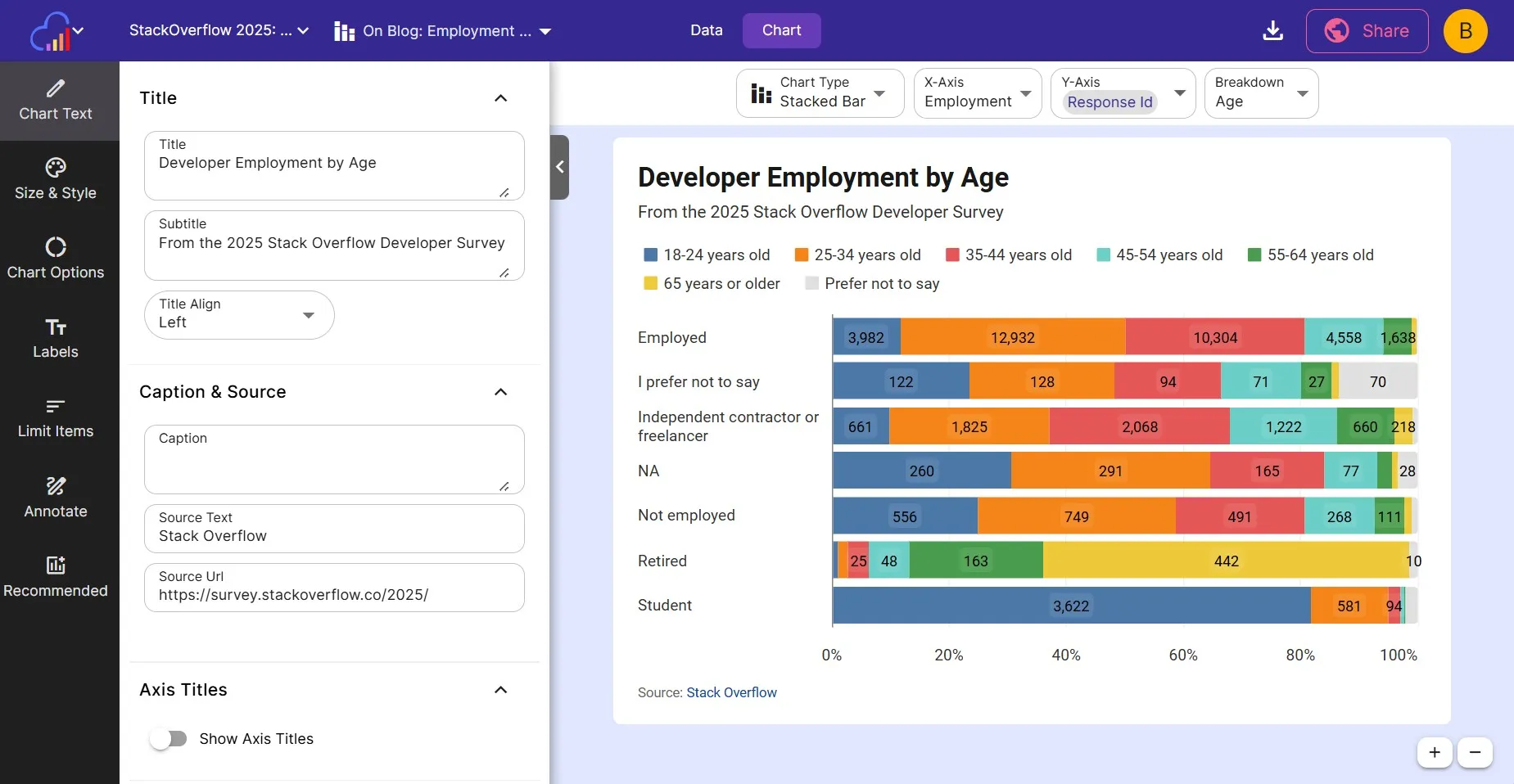 Quickly edit your survey results chart on the Chart tab.
Choose Chart Type
Matching your question type to the right chart is the secret to clarity.
The Bar Chart (Best for Single Choice)
If you asked a question like “Which of these features do you use most?”, a standard bar chart works well. It clearly ranks responses from most to least popular.
The Pie Chart (Best for Parts-of-a-Whole)
Use this for simple demographics or “Yes/No” questions.
Tip: Avoid pie charts if you have more than 5 categories; they become cluttered and hard to read quickly. (Or use Limit Items to restrict the pie chart to the top 5 categories: turn Auto Limit off in the Data panel, enable Limit Top Items, and group the rest into All Others.)
The Stacked Bar Chart (Best for Likert Scales)
This chart type is well suited to Likert Scales (e.g., Strongly Disagree to Strongly Agree).
Why it works: It allows you to see the total volume of responses while simultaneously showing the internal breakdown.
To compare groups of different sizes, open the Chart Options panel and turn on Normalize. Every bar then stretches to 100%, so each segment shows a share of responses instead of a raw count. Turn on Horizontal Bars in the same panel when the answer labels are long.
Multi-select Questions
Questions such as “Which of these browsers do you use?” often export as one cell holding several answers, like Chrome, Firefox. InstaCharts has a Multiple Choice column type for these cells. When a Multiple Choice column is plotted on an axis or as a breakdown, each selection is counted as its own category, so a respondent who chose three answers counts once toward each of them. The bars then add up to more than the number of respondents. If a multi-select column was read as plain text, open its header menu on the Data tab and change the type to Multiple Choice.
Effective Chart Types for different survey questions
Below is a summary of which types of charts are best suited for each type of survey question.
| Question Type | Best Chart | Why? |
|---|---|---|
| Demographics | Pie or Bar | Shows simple distribution. |
| Preference (Ranked) | Horizontal Bar | Easy to read long text labels. |
| Multi-select | Horizontal Bar | Each selection is counted as its own bar. |
| Likert Scales (1-5) | Stacked Bar | Shows intensity of feeling across groups. |
| Trends over Time | Line Chart | Shows if satisfaction is rising or falling. |
Edit/Transforming Data
Most of the time, survey results come from 3rd party software and may require some light editing.
Typically, survey data is formatted so each question has its own column. This can make plotting overall results (from multiple questions) tough. Luckily, you can use an Unpivot Transformation to condense multiple question columns into just 2 columns, which allows you to plot multiple questions in the same chart.
Note: Data Transforms affect all charts in a sheet; If you’ve already created charts, it may be best to copy your data into a separate sheet before using a transform so you don’t affect the other charts in the sheet.
Survey responses keep arriving after you first import the file. When you export a newer version, right click the sheet in your workspace and choose Update Data. Add rows to this sheet appends the new responses to the existing ones, and Add columns to this sheet adds a question that was added to the survey. Your charts keep working. See Update Sheet Data for the steps.
Further Customize the Chart
Once you have the chart type and axis figured out, the chart can be refined further via the left sidebar of the Chart tab.
- Chart Text Edit the chart title, subtitle, caption, source text and link and change the chart’s language locale. Axis titles and the legend are in the Axes & Legend panel.
- Chart Appearance Change the chart’s theme, width, height, colors & fonts in the Size & Style panel.
- Limit Items Too many items appearing in the chart? New charts start with Auto Limit on, which keeps the 50 largest items. Turn Auto Limit off in the Data panel to choose your own number.
- Filter Data Restrict the data that appears in the chart, such as one demographic group.
- Annotations Add text callouts and trend lines to your chart (image annotations are a paid feature).
- Number Formatting Change how numbers are formatted in the chart, in the Axes & Legend panel.
Export & Share
Share charts through the Share & Templates dialog, located on the main toolbar (sharing is an accounts only feature). You can share a copy of the interactive chart via a public link, embed it in a website, or share a static image that updates when the chart changes. A public link lets viewers see all of the data in the sheet, so keep respondent details private by importing only the columns you plan to chart.
Need to use the chart image in a report? Use the Export dialog to export images as a PNG, JPG, SVG, WebP, PDF, or PowerPoint slide.
You can also use the Export window to export your data as a csv, excel, tsv or json file.
Ready to see your survey data in action?
InstaCharts turns raw survey data into professional, shareable visuals in minutes, without hours of manual formatting or writing any code. Sign up for a free account today!