
Quick Start
InstaCharts is an online chart maker that creates interactive charts from spreadsheet data. Upload a CSV or Excel file, pick a chart type, and get a publication-ready chart in seconds - no formulas or coding required.
Charts can be exported as image files or shared online as interactive, embeddable charts.
Here’s an example of an embedded interactive chart:
Sign up for an account
Create a free InstaCharts account to save your data and share charts publicly. Sign up here.
If you’re not ready to sign up, try the demo with no account needed.
Import Spreadsheet Data
InstaCharts supports several ways to import data: upload a spreadsheet file from your computer, import and sync a file from a link, sync a Google Sheet, or start a blank sheet and type or paste your data into a spreadsheet editor.
This guide covers file upload, the fastest way to create a chart from your data.
For the best results, structure your spreadsheet first: see Formatting Data for Import for how to lay out rows, columns, header names, and data types.
Upload a Spreadsheet File
From your workspace, click New -> New Sheet. Click Upload a file, then select a spreadsheet from your device. InstaCharts processes the file and generates a chart automatically - no manual configuration needed.
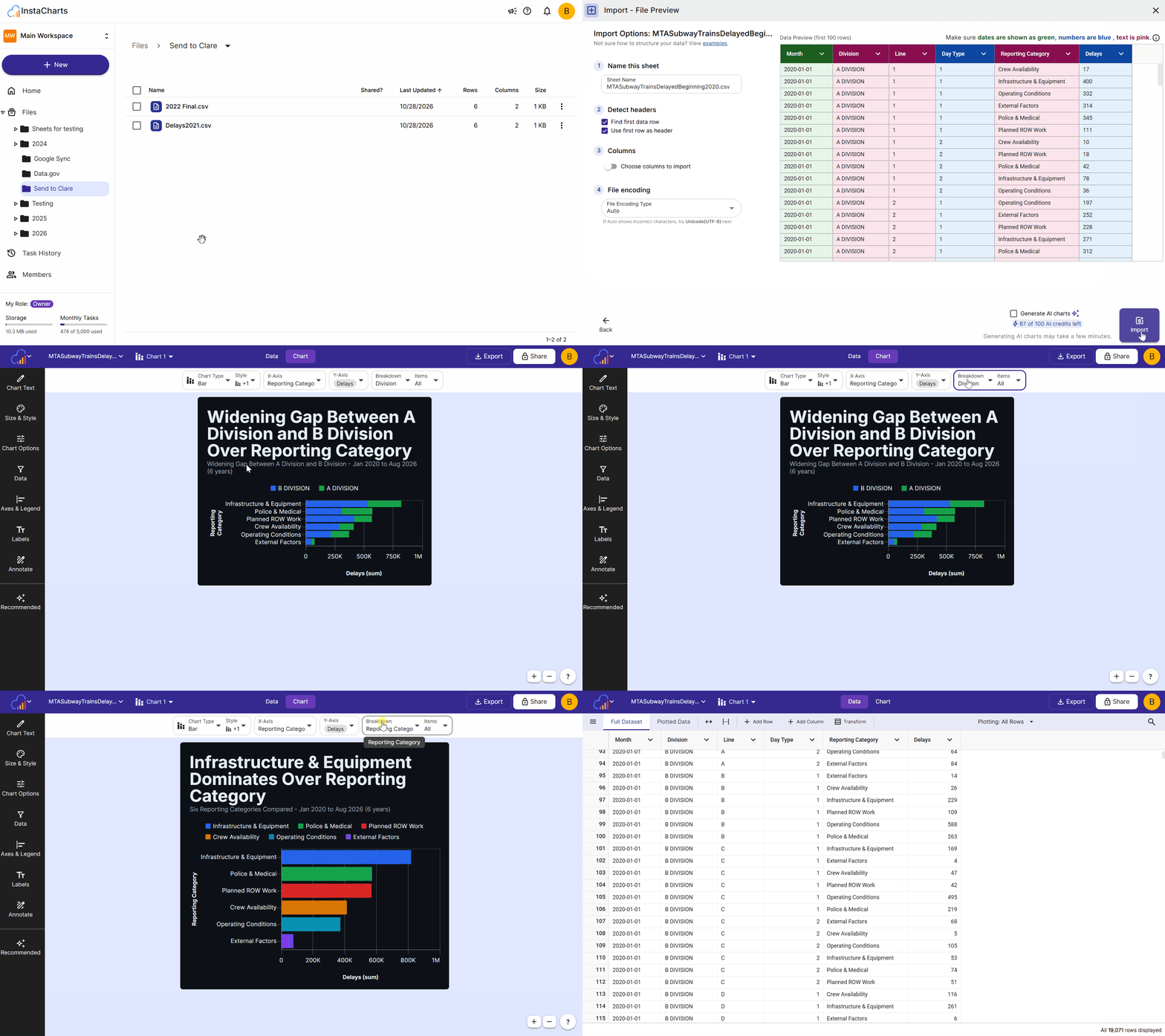
Supported file formats: CSV, Excel (.xlsx/.xls), TSV, PSV, OpenDocument, Apple Numbers, JSON, and log files. See Import File for the full list and for the import options that control the header row, the columns imported, and the file encoding.
You can also drag and drop a spreadsheet file straight onto your workspace to import it with the default options. A workbook with several pages creates one sheet per page.
Check Your Data
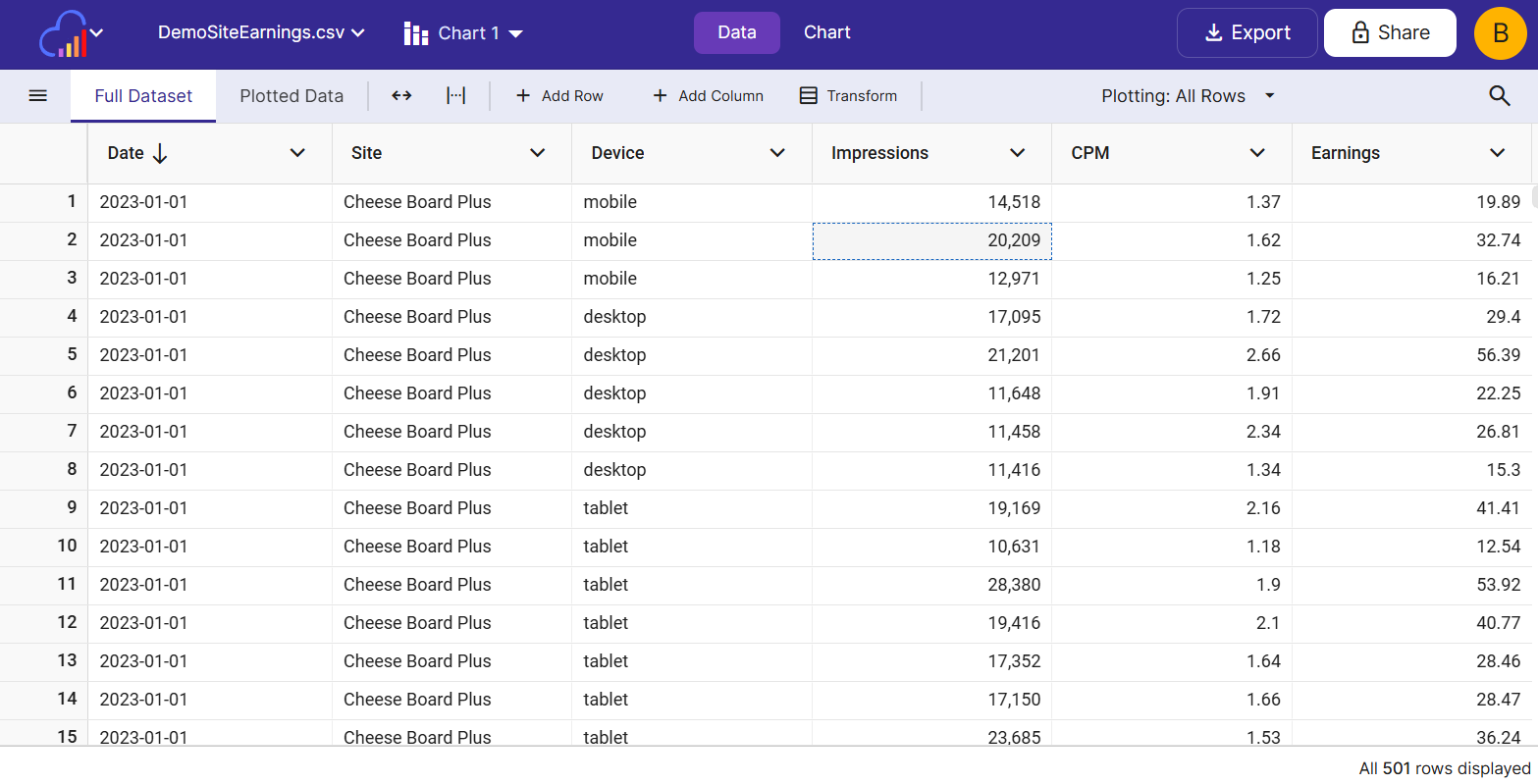
After uploading, click the Data tab and open Full Dataset to see how InstaCharts read your spreadsheet. Column types (dates, numbers, categories) are detected automatically, which affects chart type recommendations and axis options.
Create and Edit Your Chart
Click the Chart tab to view the generated chart.
InstaCharts picks a chart type and axes automatically. The chart toolbar above the chart holds the dropdowns that change the chart type, the chart style, and the spreadsheet columns plotted on each axis.
Choose a Chart Type
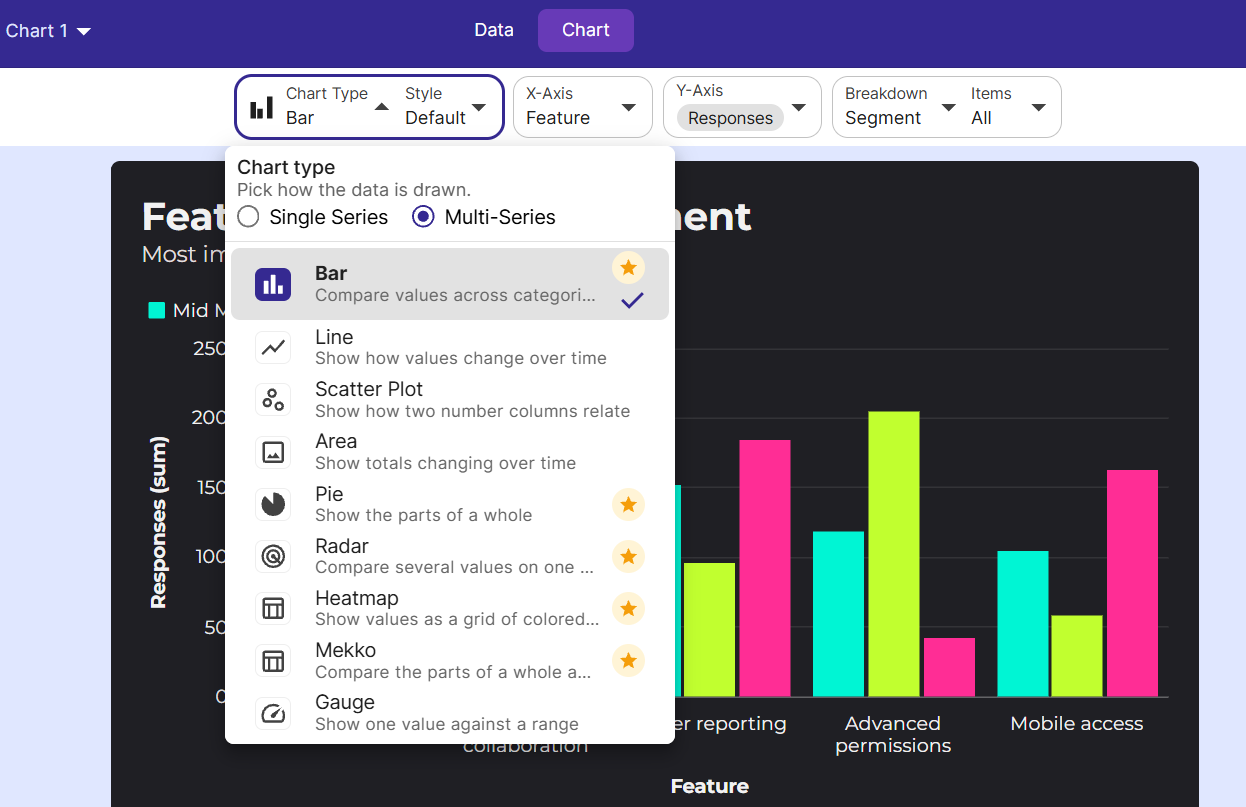
Open the Chart Type dropdown to pick how your data is drawn. Each chart type in the menu has a short description of what it shows best:
- Bar compares values across categories
- Line shows how values change over time
- Scatter Plot shows how two number columns relate
- Area shows totals changing over time
- Pie shows the parts of a whole
- Radar compares several values on one shape
- Heatmap shows values as a grid of colored cells
- Mekko compares the parts of a whole across categories
- Gauge shows one value against a range
Single Series and Multi-Series Charts
Bar, Line, Scatter Plot, Area and Gauge charts have Single Series and Multi-Series options at the top of the Chart Type dropdown. A single series chart draws one set of values in one color. Multi-Series switches to the grouped version of the chart and shows the Breakdown dropdown, so each value in the Breakdown column gets its own color. The grouped versions are Grouped Bar, Grouped Line, Grouped Scatterplot, Grouped Area and Grouped Gauge.
The toolbar also switches versions for you as you work. Picking a Breakdown column or adding a second series switches to the grouped version, and picking None in the Breakdown dropdown switches back to a single series chart. Choosing Single Series removes the Breakdown and any extra series.
Choose a Chart Style
The Style dropdown sits next to the chart type and holds the options for the chart type you picked. The toolbar shows the first option that is turned on, along with a count of any others.
- Bar Stacked Bars, Normalize, Horizontal Bars and Waterfall Bars. Stacked Bars turns a grouped bar chart into a Stacked Bar chart and is available once the chart has a Breakdown or a second series
- Line Smooth Lines and Show Markers, with a Line Width slider
- Area Smooth Lines, Fade and Show Markers, with Fill Opacity and Line Width sliders. Grouped area charts add a choice of Stack, Normalize or No Stack
- Pie Semi Circle, with Donut Inner Size and Border Radius sliders
- Radar Fade and Show Markers, with Fill Opacity and Line Width sliders
- Heatmap Fill in Missing Values
- Gauge Needle Dial, Degrees and Band Thickness sliders, and Min, Max and Target boxes
- Grouped Gauge a Ring Width slider, and Min, Max and Target boxes
These are the same settings found in the Chart Options panel in the left sidebar.
Choose Your Axes
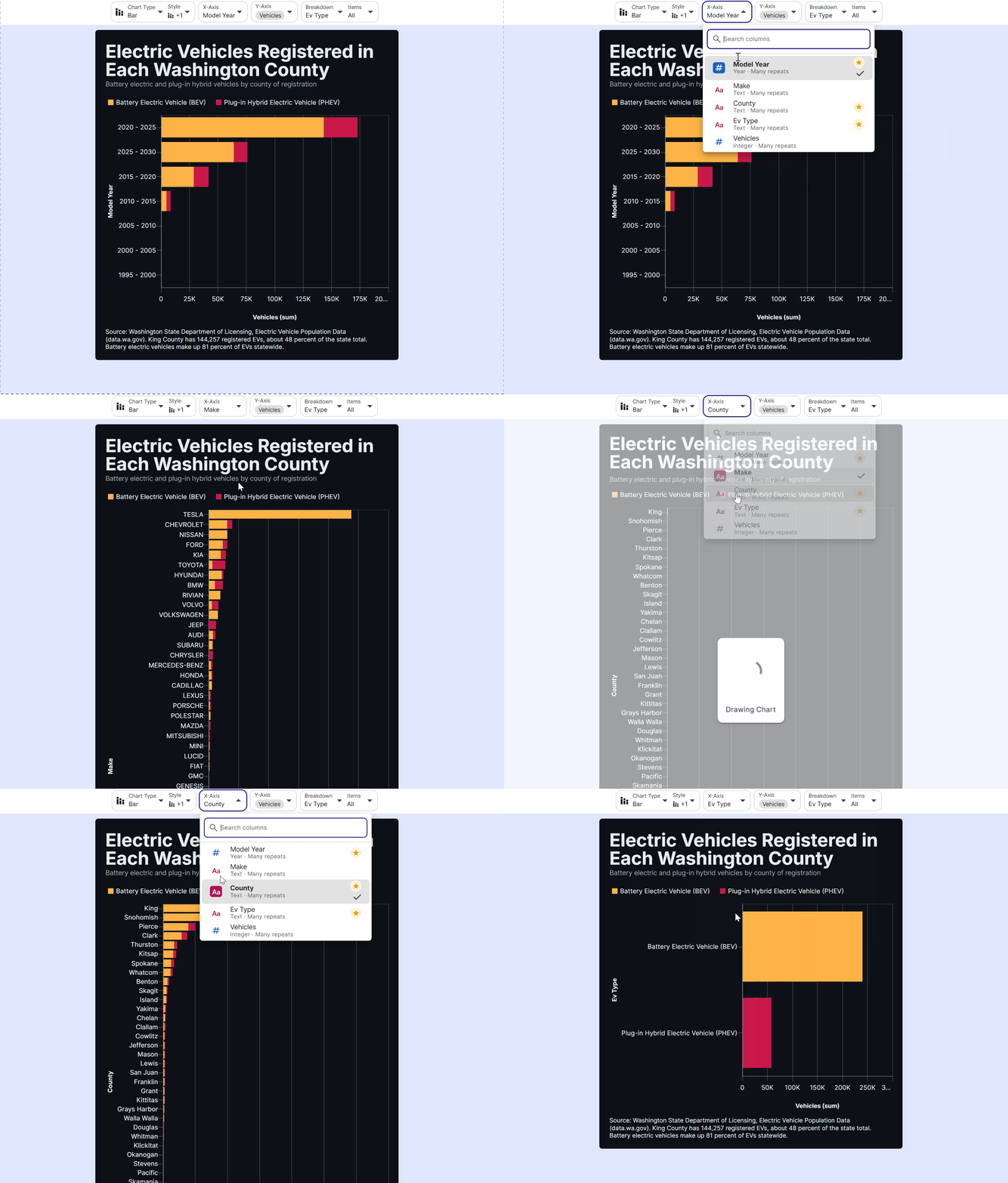
After selecting a chart type, assign your spreadsheet columns to each axis. This controls what data appears in the chart.
-
X-Axis: typically a date, time period, or category column. This is the horizontal axis of your chart. Pie and gauge charts hide the X-Axis dropdown.
-
Y-Axis / Series: typically a numeric column, plotted on the vertical axis. Pie, gauge and heatmap charts label this dropdown Values. On Bar, Line, Area, Gauge, Pie, Radar and Mekko charts it opens a series menu, where you can click Add Series to chart more than one column, remove a series, pick the color of each series, or click Remove All to go back to one column.
-
Breakdown: splits the values into groups using a column like region, product, or status, and draws each group in its own color. Pick None, or click the delete button in the column menu, to remove the Breakdown. Heatmap charts label this dropdown Y-Axis. The Breakdown dropdown is hidden once a chart has more than one series, because each series already has its own color.
Pick a Column
Each axis dropdown opens a column menu that makes it easier to find the right column in a large spreadsheet.
- Search type part of a column name to find it
- Type filters sheets with 6 or more columns show All, Numbers, Text and Dates filters, with the number of columns of each type
- Recommended columns a star marks the columns recommended for that axis and chart type
- Column details hover over a column to see its type, how it will be charted, how many unique values it has, and a few example values
- Columns with one value a column where every row has the same value is shown in grey with an info icon, since a single repeated value makes a flat chart
On phones, each toolbar menu opens full screen.
Plot As
When the values in a column can be read in more than one way, a Plot As dropdown appears next to the column. Choose Date to put the values on a date axis, Number to place them on a number scale, or Text to treat each value as its own category. Each choice shows how many values in the column can be read that way.
Time Unit
When a date column is plotted, the Time Unit dropdown groups the dates. You can pick more than one unit, such as Year and Month, and the menu shows a preview of how the chart labels will look. A star marks the units recommended for the column’s dates. Picking a unit removes any chosen units it can’t be combined with. Hours and Minutes are available for columns that contain timestamps.
Math
When multiple spreadsheet rows share the same X value, the Math dropdown next to the Y-Axis column picks the aggregation function, like sum, count, or average, that combines them into a single chart value. A star marks the recommended choice, Sum or Average, based on the column name. Scatter plots draw every row and hide the Math dropdown.
Breakdown Items
When a Breakdown has 50 items or fewer, an Items dropdown appears next to it so you can choose which items show in the chart. Check or uncheck each item, or use Select All and Deselect All. Each item also has a color button to change the color it is drawn in, and Reset Colors returns every item to the color scheme. The dropdown shows All, or a count such as 3 of 8 when only some items are checked.
Further Chart Customization
The left sidebar has options for title and axis labels, colors and chart size, and limiting which items appear.
To filter the data included in the chart, use column filters on the Data tab.
Multiple Charts from One Dataset
To create several charts from the same spreadsheet, click the spreadsheet name in the main toolbar, then Add Chart. Each chart has its own axis settings and filters, so they can show completely different views of the same data.
Next Steps
- Update a sheet with a newer version of your file
- Export chart images
- Export spreadsheet data
- Share an interactive chart
- Combine charts, tables and KPIs into a dashboard