Share Charts
InstaCharts makes it easy to share your charts and data with anyone - no InstaCharts account required. Sharing works through a URL link you can send via email, Slack, or any messaging tool. You can also embed charts directly into websites, dashboards, and web apps.
Charts can be shared as interactive charts (where viewers can hover, explore data, and switch views) or as static images. You can share publicly with anyone who has the link, or privately with specific users.
To share a chart, first make sure you are logged into your InstaCharts account. If you don’t have an account, sign up here.
Share & Templates Dialog
To open the Share & Templates dialog, click the Share button on the main toolbar. The Share dialog is also accessible through the File Menu.
Share Interactive Chart
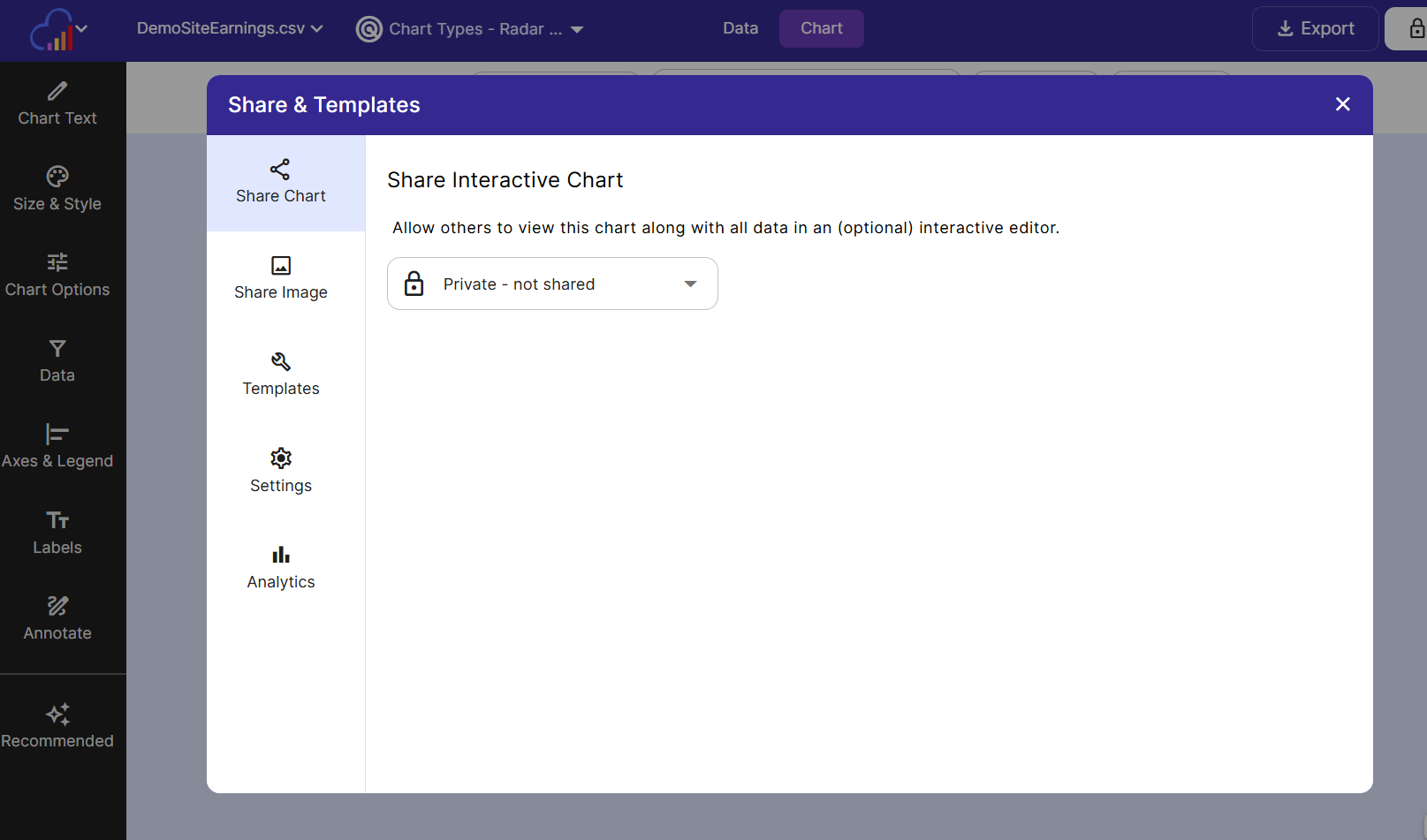
On the left side menu of the Share dialog, make sure Share Chart is selected.
Share Mode
There are three share modes accessed via the share type dropdown:
- Private: Only you can access
- Share with specific users: Only shared with users you specify (for paid users only)
- Public: Anyone with link can access
Share Publicly
To share your chart, change the share mode to Public. Anyone with the url will be able to view your interactive chart (no account needed).
If you no longer wish to share this chart, set it to private.
To share a chart with someone, copy the Interactive Chart URL and send it to them.
Share Privately 🔒 (paid feature)
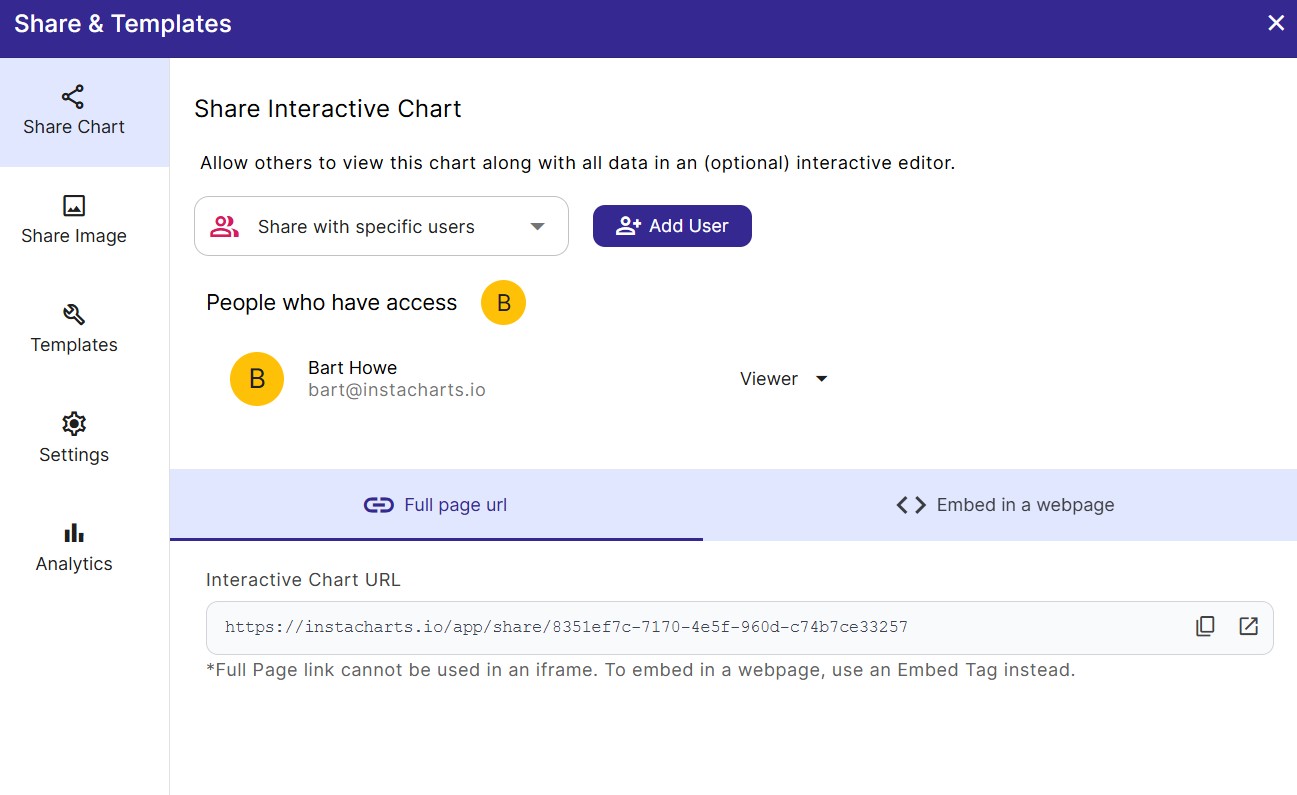
To share your chart with specific users, change the share mode to “Share with specific users”.
- To grant another user access, decide if you want to send them an email notification with a link to the share. If not, unclick Send Email.
- Type in their email address into the Add email addresses box. When you are done, press enter.
- Permission has been granted, and the user will appear under People who have access. To remove their access, click Viewer, then Remove Access.
Share Settings
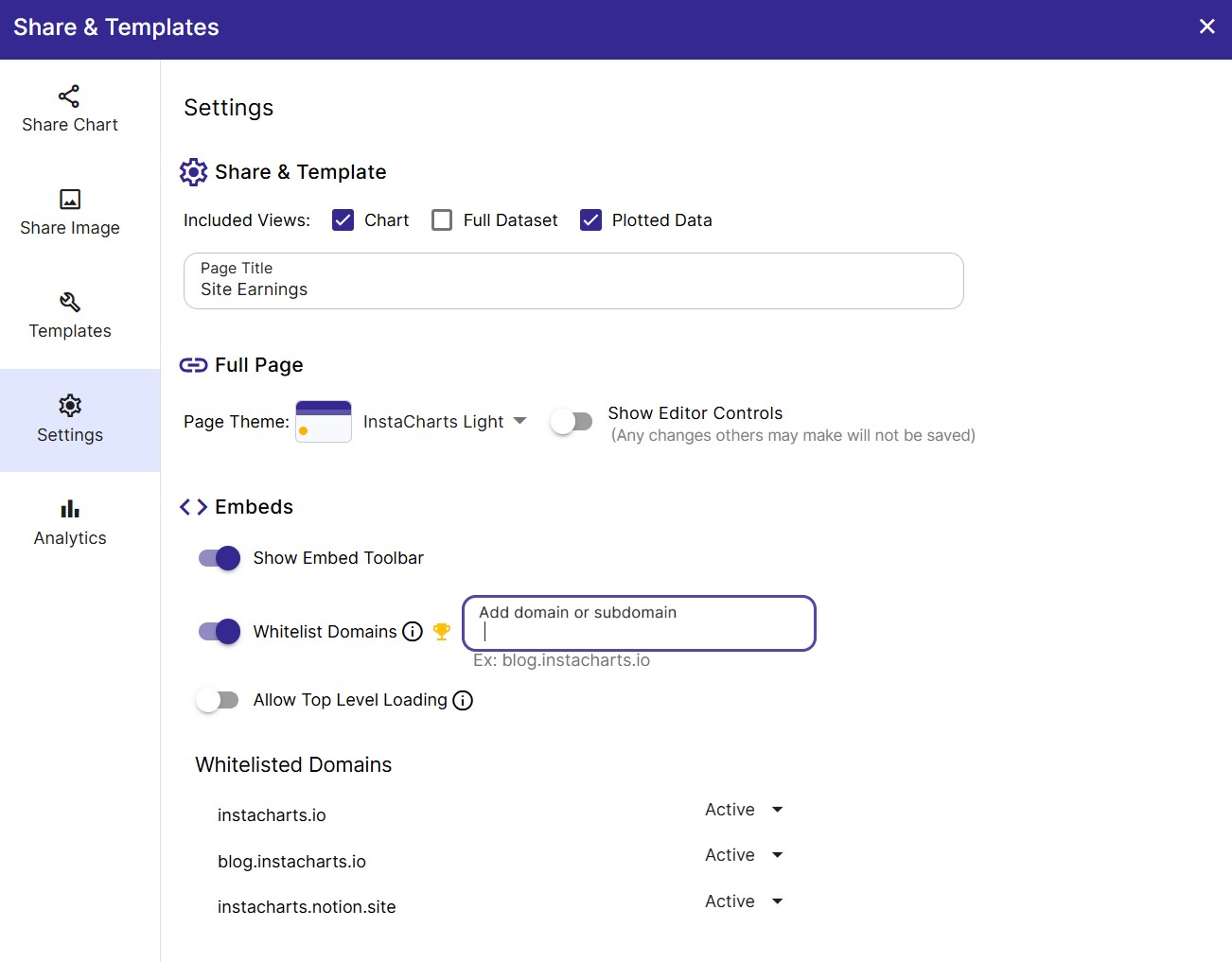
If the chart is currently shared, options appear under the Settings tab that allow you to customize the share.
Included Views
Each shared chart can have up to 3 different views enabled. Use the checkboxes to select which views should be included in the share.
Views:
- Chart : Show the chart
- Full Dataset : Show the full dataset as a data table.
- Plotted Data : Show the data plotted in the chart as a data table.
If more than one view is selected, a dropdown will appear in the share that allows you to switch views.
DataTable Colors
When Full Dataset or Plotted Data is selected, the DataTable Colors dropdown appears next to the views. It sets the color scheme of the data tables in the full page interactive chart and in embeds.
- Light: Data tables use a white background with dark text.
- Dark: Data tables use a dark background with light text.
- Match Chart: Data tables follow the chart’s background color. A dark chart background gives dark tables, and a light or transparent chart background gives light tables.
Match Chart keeps an embed looking consistent when viewers switch between the chart and its data, since the tables pick up the same light or dark look as the chart.
Page Title
Optionally change the page title of the shared chart
Chart Sizing
Chart Sizing controls how the chart fills a browser window or embed frame that is smaller than the size you built the chart at.
- Responsive: The chart redraws itself to fit the space it has. Text stays full size, and the layout adjusts for small screens. Embeds fill the height of the frame on your website.
- Scale chart to fit screen: The chart is drawn at the size you built it and then shrunk to fit, so it looks the same as it does in the editor. Text shrinks along with the chart. Embeds resize their frame to the height of the chart.
Choose Responsive for charts that need to stay readable on phones. Choose Scale chart to fit screen when the chart has to keep the exact layout you designed.
Page Theme
Change the page theme of full page interactive charts. There are currently 12 themes to choose from.
Themes do not apply to embeds, full page interactive charts only.
Show Embed Toolbar
This controls whether the bottom toolbar is shown on embedded charts and data tables. The embed toolbar contains:
- A dropdown to switch between views
- An Export button to export the chart image or download data
- A View Larger button to open the embedded chart into a new tab. This button is hidden when Allow Top Level Loading is off.
Match Toolbar to Chart
When Show Embed Toolbar is on, the Match Toolbar to Chart toggle appears next to it. Turn it on to color the embed toolbar with the chart’s background color, so the toolbar blends into the chart.
Show Editor Controls
Sometimes a dataset is best represented by multiple charts instead of just one. Enable the editor controls to allow a viewer to change chart axis, chart type and many other chart settings to change the chart that is displayed.
Whitelist Domains 🔒 (Paid Feature)
Domain Whitelisting is a security feature that prevents your charts from being embedded and displayed on unauthorized websites. By default, charts are embeddable anywhere. To enable this restriction, you must specify the exact subdomains allowed to display the chart content.
You must enter the full domain or subdomain where the chart will be embedded. Wildcards are not supported.
| Domain Type | Input Example | Chart Display Location |
|---|---|---|
| Main Domain | example.com | https://example.com/page |
| Standard Subdomain | blog.example.com | https://blog.example.com/post |
| Specific Path (Not supported) | example.com/page | The system ignores paths and only uses the domain. |
Example: If you only add reports.clientportal.com to the whitelist, the chart will not load on www.clientportal.com or any other site.
The whitelist applies to everything shared from the chart: the interactive chart, its embed, the shared chart image and the chart template.
Allow Top Level Loading
When Whitelist Domains is turned on, the Allow Top Level Loading toggle appears next to it. Top level loading means opening a chart URL directly in the browser address bar, such as the full page interactive chart link or the full page template link. The toggle is on by default, and the caption under it shows what viewers can currently open.
- On (Embeds & Full Screen Shares are viewable): Embeds load on your whitelisted domains, and anyone with the link can open the full page interactive chart.
- Off (Only embeds are viewable): Embeds load on your whitelisted domains, and full page views of the chart are turned off.
Turning Allow Top Level Loading off changes the share in these ways:
- The full page interactive chart link and the full page template link show a “This chart is private or no longer shared” page in place of the chart.
- The Full page url tab is hidden under Share Chart and under Templates in the Share dialog.
- The View Larger button is removed from the embed toolbar, and from the menu on small embeds.
- Shared image URLs and template image URLs load only inside an
<img>tag on a whitelisted domain. Opening them directly in the browser address bar is blocked.
Turn it off when a chart should only be viewable inside your own website or web app.
Embed in a webpage
Charts, datatables and images can also be embedded into webpages. There are two ways to embed an item into a webpage:
- Embed Url Copy this url and paste it into services that take an embed url, like Notion.
- Embed Tag Copy this html iframe tag and paste directly into an html webpage or a service that accepts html tags.
Next to the Embed Tag type, the SEO data and SEO caption toggles add a description of the chart to the Embed Tag. SEO data adds JSON-LD structured data, and SEO caption adds a visible caption below the chart that search engines index as part of your page. See Improve SEO for Embedded Charts for details.
Embed in a Website Builder
Below is how to integrate with different website builders as of Jan 2026:
- Bubble Drag an HTML Element onto your page, then paste in the Embed Tag under Appearance.
- Webflow Add a Code Embed Element to your page, then paste in the Embed Tag.
- WordPress Use the Embed Tag and paste it into a Custom HTML block
- Ghost Add a raw HTML card and paste in the Embed Tag
- Notion Add an Embed Block, and paste in the Embed URL
- Medium Medium doesn’t support many third party services by design. Download your chart image to svg or png, and upload the image to your Medium article.
- Substack Substack also doesn’t support many third party services by design. Download your chart image to svg or png, and upload the image to your Substack article.
- Wix Add an HTML Embed Element. Choose Website address and paste in the Embed URL or choose Code and paste in the Embed Tag.
- Squarespace Add an Embed Block. Embed as a Code Snippet, then paste in the Embed Tag.
- Shopify Add a Custom Liquid Section. Paste the Embed Tag into the Liquid code text area.
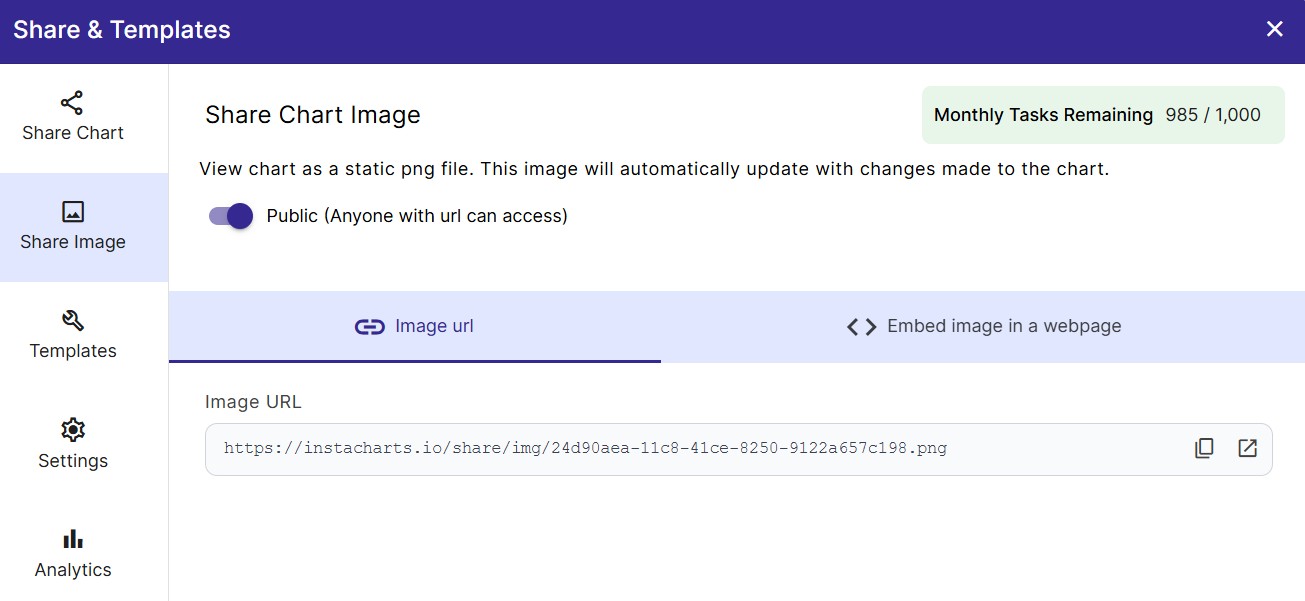
Share Chart Image
You can also share static chart images with others. These images will automatically update with any changes made to the underlying chart.
Much like shared interactive charts above, shared images can either be shared via a url link or embedded into a website.
Currently shared images are only available in .png format.
Analytics 🔒 (Paid Feature)
The Analytics tab of the Share & Templates window shows how many people are viewing the chart. View counts are split between Shares (the full page interactive chart) and Embeds (the chart loaded inside another website), with a daily trend for the last 30 days, a monthly trend for all time, and the top pages embedding the chart. Every table can be exported to CSV.
See Share Analytics for what each metric means and how views are counted.
Templates
The last tab of the Share & Templates window allows you to create templates to simplify the chart generation through an API process.
Frequently Asked Questions
Do viewers need an InstaCharts account to see a shared chart? No. Anyone with the link can view a publicly shared chart or embedded chart without an account.
Can viewers edit my chart or change my data? Viewers can change chart display options (axis, chart type, colors) to explore the data, but their changes are not saved and do not affect the original chart.
What is the difference between sharing a link and embedding? Sharing a link sends the viewer to a standalone InstaCharts page. Embedding displays the chart inside your own webpage using an iframe, so the chart appears as part of your site.
What is the difference between an interactive chart and a shared image? An interactive chart lets viewers hover over data points, switch views, and explore the data. A shared image is a static PNG that automatically updates when the underlying chart changes, but has no interactive controls.
Can I stop sharing a chart at any time? Yes. Set the share mode back to Private at any time, and the link will stop working immediately.
Why is my embedded chart not showing on my website? If you have Domain Whitelisting enabled, make sure your site’s domain is listed exactly as it appears. A whitelist with no domains blocks the embed on every site. If whitelisting is not configured, the chart should embed on any site.
Why does my share link say “This chart is private or no longer shared”? Check the share mode first, since a Private chart shows this page. If the chart is Public, check whether Domain Whitelisting is on with Allow Top Level Loading turned off. That combination turns off the full page interactive chart and the full page template link, so the chart can only be viewed as an embed on a whitelisted domain.