
Filtering
InstaCharts allows you to set a series of filters on your full dataset to limit the amount of rows shown in your chart. To keep only the largest or smallest values instead, use Limit Items.
Filters can be found in two places: on the Data tab’s Full Dataset view, and in the Data panel of the chart editor’s left sidebar. The Data panel has two filter cards:
- Simple Filters removes blank values and zeros from the chart with a toggle, and holds the Quick Filter box.
- Column Filters sets a series of filters on each column. These are the same filters found in the column menus on the Data tab, so setting one updates the other.
Simple Filters
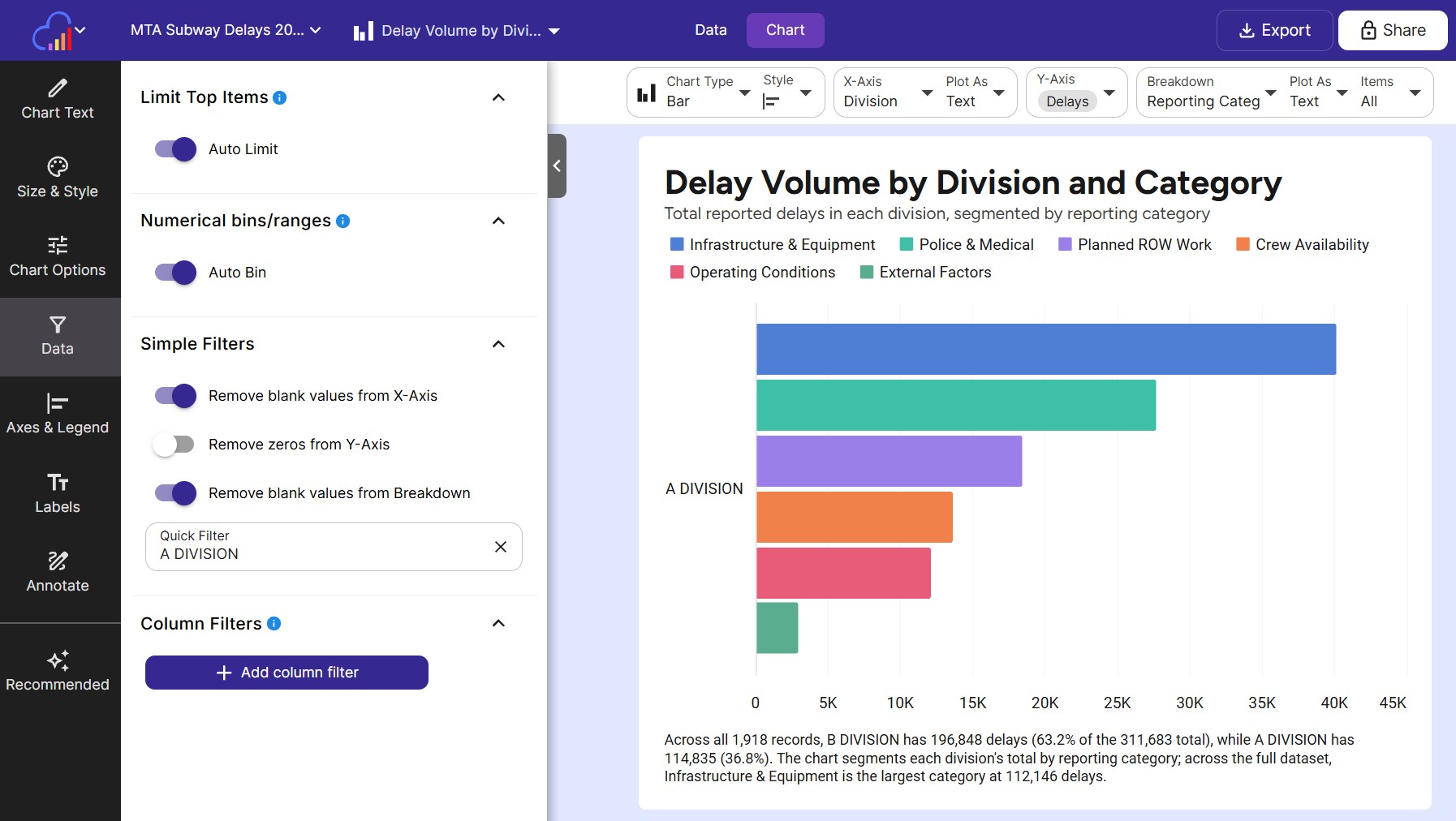
The Simple Filters card in the Data panel holds quick toggles for cleaning up a chart. Each toggle is named after the axis it applies to.
- Remove blank values from X-Axis Removes rows with an empty X-Axis value, so the chart has no blank category. This toggle is on for new charts. It is hidden on pie charts that plot more than one series.
- Remove zeros from Y-Axis Removes any item whose Y-Axis value adds up to 0 after aggregation. This toggle is off for new charts. Pie charts always leave out slices with a value of 0.
- Remove blank values from Breakdown Removes rows with an empty Breakdown value, so the legend has no blank item. This toggle is on for new charts, and appears on chart types that use a Breakdown when the chart plots a single series.
- Quick Filter Type a word or number to keep only the rows that contain it. This is the same Quick Filter as the magnifying glass in the sheet toolbar, described below.
Quick Filter
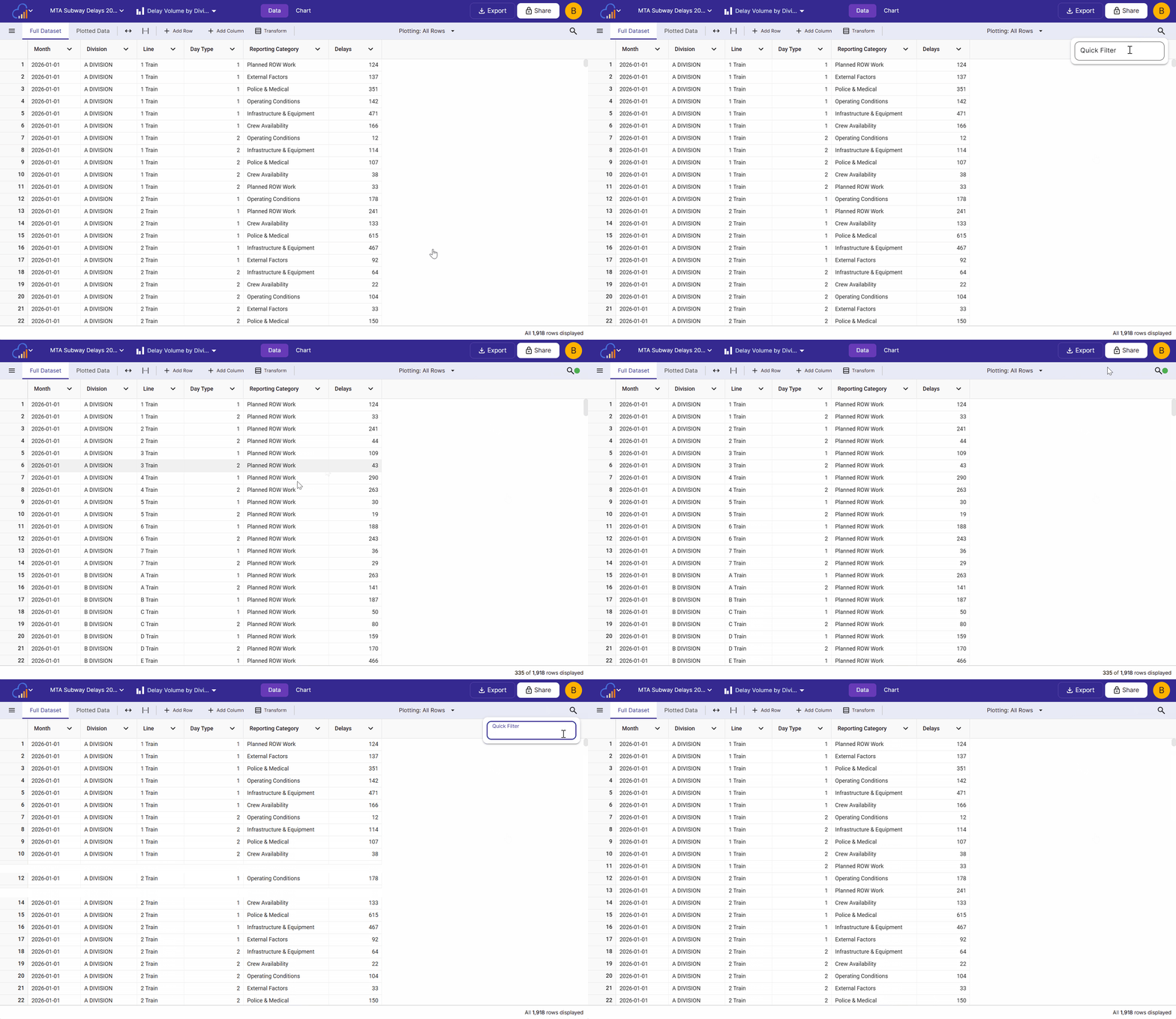
To quickly filter the data that appears in the chart, click the magnifying glass in the sheet toolbar, or use the Quick Filter box in the Simple Filters card, and type in a word or number that appears in all rows you want to appear in the chart.
Column Filters
In the Full Dataset view, every column header contains a dropdown menu icon. Click it to launch the column menu, then click Set Filters to launch the Column Filters dialog.
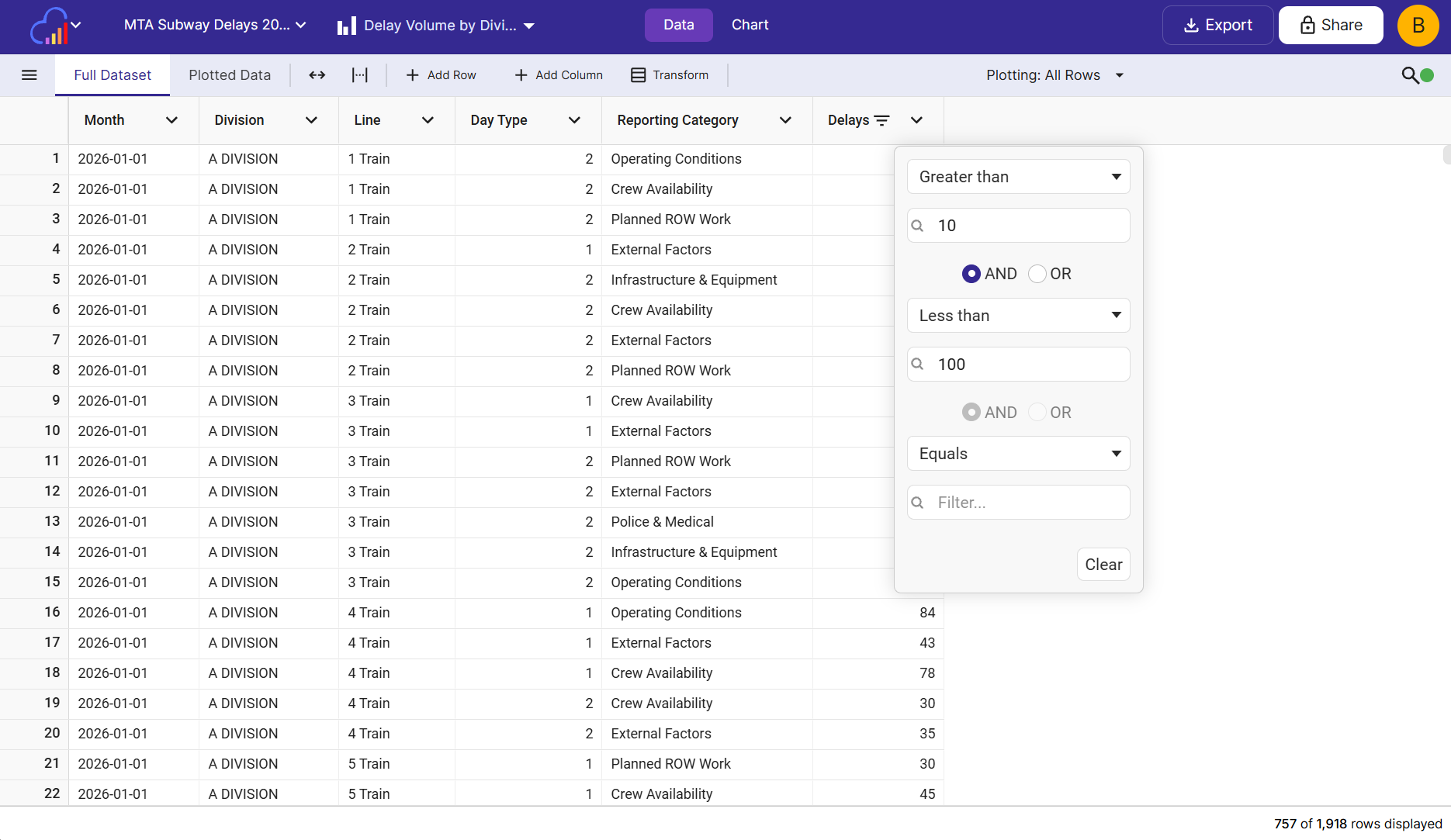
To set the same filters from the chart editor, open the Column Filters card in the Data panel and click Add column filter. Search for the column, pick it from the list, then choose a filter type and enter a value. Click Add filter to add another condition to the same column, or click the X beside a condition to remove it. A badge on the card title shows when the chart has column filters set.
You can set up to 5 filter conditions on a single column, and choose whether they combine with And or Or. The filter types are explained below.
Text Filter
Filters on text columns include:
- Contains and Does not contain
- Equals and Does not equal
- Begins with and Ends with
- Is blank and Is not blank
Number Filter
Filters on numerical columns include:
- Equals and Does not equal
- Greater than and Greater than or equal to
- Less than and Less than or equal to
- Between (inclusive of both ends)
- Is blank and Is not blank
Date Filter
Filters on date columns include:
- Equals and Does not equal
- Before
- After
- Between (inclusive of both ends)
- Is blank and Is not blank
Remove Filters
There are three ways to remove a column filter:
- Select Remove Filters from the column dropdown menu
- Press the Clear button from inside the Column Filters dialog.
- Click the X beside each condition in the Column Filters card of the Data panel.
Plotting Selected Rows
Use Plotting to hand pick the exact rows a chart uses. This is helpful when the rows you want have nothing in common that a filter can match, such as a few chosen products or a handful of dates.
The Plotting dropdown sits in the toolbar above the Full Dataset view on the Data tab, and reads Plotting: All Rows by default. On a small screen it is in the toolbar’s More Actions menu. It has two options:
- All Rows All unfiltered rows in the sheet are used in the chart.
- Selected Rows Only the rows you select are used in the chart.
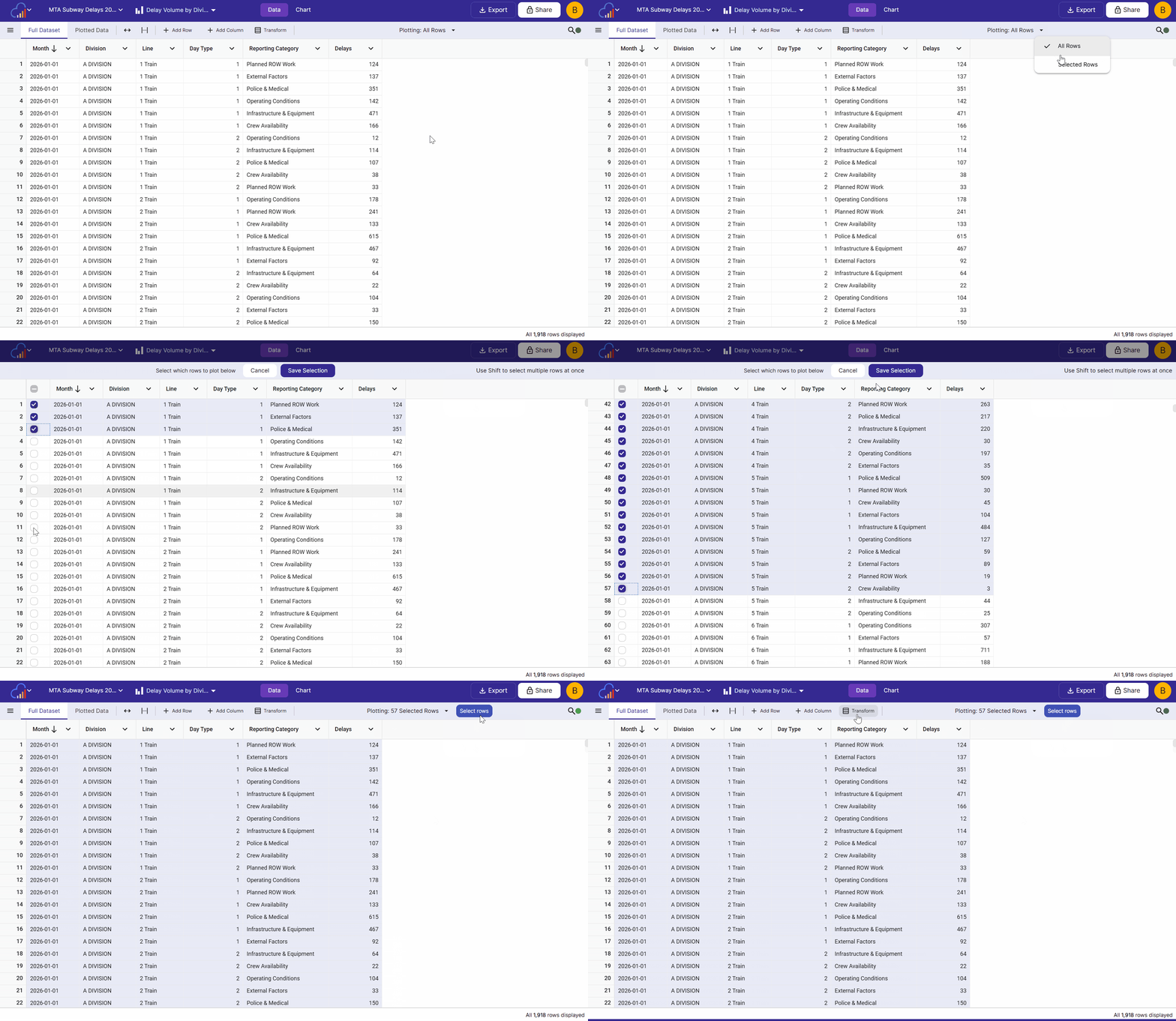
To plot selected rows:
- Open the Plotting dropdown and choose Selected Rows. The first time you choose it, InstaCharts switches the data table into row selection mode.
- Click each row you want to plot. Hold Shift and click to select a range of rows at once.
- Click Save Selection to save the rows and update the chart, or click Cancel to leave without saving.
After saving, the dropdown reads Plotting: 12 Selected Rows (with your number of rows), and the selected rows are highlighted in the data table. Click the Select rows button beside the dropdown to change the selection. Your saved rows are already checked when the table opens, so you can add or remove rows from there. Choose All Rows at any time to go back to plotting every row.
A few things to keep in mind:
- A selection can hold between 1 and 10,000 rows.
- If you cancel before saving any rows, Plotting switches back to All Rows.
- Each chart keeps its own selection, so other charts on the same sheet keep plotting their own rows.
- The Quick Filter, Simple Filters and Column Filters still apply on top of the selected rows. A selected row that a filter removes stays out of the chart.
Related
- Limit Items - cap the chart to the top or bottom values
- Column Types - how text, number and date columns are detected
- Aggregation - summarize the filtered rows
- Transform Data - reshape data before charting