
Size and Style
The Size & Style panel contains options to change the chart’s theme, colors, size, fonts, grid and axis styles.
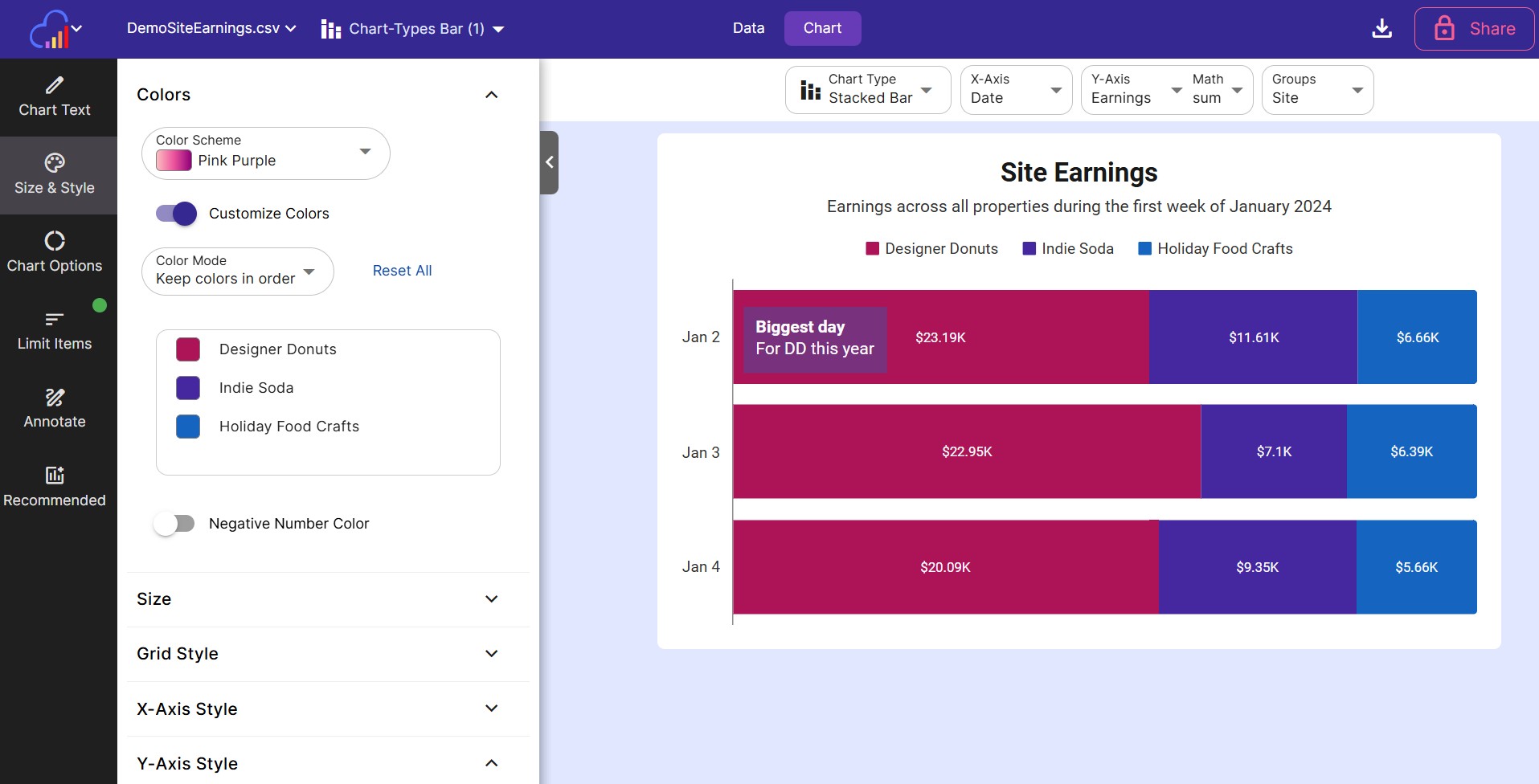
Chart Themes
A theme sets a chart’s background color, color scheme, fonts, and grid and axis style all in one step. Open the Chart Theme dropdown at the top of the Size & Style panel to browse the available themes, each shown with a small preview of its background and palette.
Applying a theme overwrites the chart’s background color, color scheme, single color, fonts (title, subtitle and axis titles), grid line opacity, axis line and tick opacities, and plot border, background and shadow. It does not change the chart type, axis type, data labels, or which columns are plotted, and any of these settings can still be fine-tuned afterward without losing the rest of the theme.
Available Themes
| Theme | Description |
|---|---|
| Classic | The InstaCharts default |
| Midnight | Built for dark social feeds |
| Studio | Modern online theme |
| Broadsheet | Newspaper data graphic |
| Neon | Loud and screenshot friendly |
| Pastel | Friendly and approachable |
| Ember | Energetic and modern |
| Financial Light | Precise, for market data |
| Financial Dark | Trading terminal style |
| Code | A coder’s terminal, dark and monospace |
Color Scheme
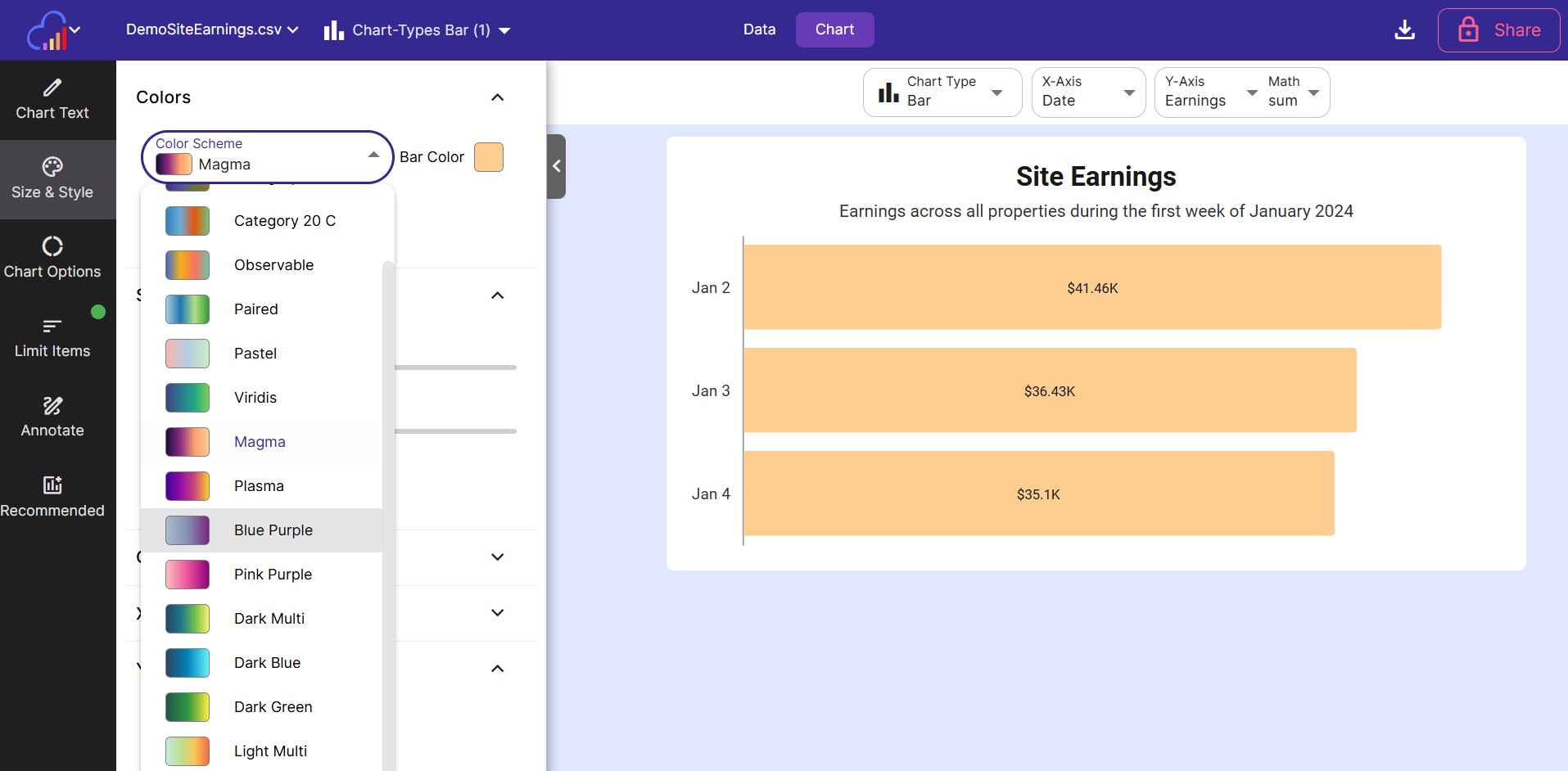
Use this dropdown to select a color scheme for the chart. Most color schemes contain 10 colors.
For charts that contain a single color (Ex: line chart), it’s possible to select an individual color. Next to the color scheme dropdown, a single color selector will appear. Click it to launch a color picker dialog.
Available Color Schemes
| Color Scheme | Type | Best for | |
|---|---|---|---|
| Tableau | Categorical | Showing different groups or categories of data | |
| Tableau 20 | Categorical | Showing different groups or categories of data | |
| Category 20 B | Categorical | Showing different groups or categories of data | |
| Category 20 C | Categorical | Showing different groups or categories of data | |
| Observable | Categorical | Showing different groups or categories of data | |
| Paired | Categorical | Showing different groups or categories of data | |
| Pastel | Categorical | Showing different groups or categories of data | |
| Executive | Categorical | Showing different groups or categories of data | |
| Excel | Categorical | Showing different groups or categories of data | |
| Minimal | Categorical | Showing different groups or categories of data | |
| Bold | Categorical | Showing different groups or categories of data | |
| Viridis | Sequential Multi-Hue | Displaying numeric values getting larger or smaller | |
| Magma | Sequential Multi-Hue | Displaying numeric values getting larger or smaller | |
| Plasma | Sequential Multi-Hue | Displaying numeric values getting larger or smaller | |
| Blue Purple | Sequential Multi-Hue | Displaying numeric values getting larger or smaller | |
| Pink Purple | Sequential Multi-Hue | Displaying numeric values getting larger or smaller | |
| Dark Multi | Sequential Multi-Hue | Displaying numeric values getting larger or smaller | |
| Dark Blue | Sequential Multi-Hue | Displaying numeric values getting larger or smaller | |
| Dark Green | Sequential Multi-Hue | Displaying numeric values getting larger or smaller | |
| Light Multi | Sequential Multi-Hue | Displaying numeric values getting larger or smaller | |
| Green Blue | Sequential Multi-Hue | Displaying numeric values getting larger or smaller | |
| Gold Red | Sequential Multi-Hue | Displaying numeric values getting larger or smaller | |
| Red Yellow Green | Diverging | Highlights numeric values with a meaningful midpoint | |
| Spectral | Diverging | Highlights numeric values with a meaningful midpoint | |
| Rainbow | Cyclical | Highlight repeating cycles within data | |
| Blues | Sequential Single-Hue | Displaying numeric values getting larger or smaller | |
| Reds | Sequential Single-Hue | Displaying numeric values getting larger or smaller | |
| Teals | Sequential Single-Hue | Displaying numeric values getting larger or smaller | |
| Purples | Sequential Single-Hue | Displaying numeric values getting larger or smaller | |
| Greens | Sequential Single-Hue | Displaying numeric values getting larger or smaller | |
| Warm Grays | Sequential Single-Hue | Displaying numeric values getting larger or smaller | |
| Studio | Theme Palette | Pairs with the Studio chart theme | |
| Midnight | Theme Palette | Pairs with the Midnight chart theme | |
| Broadsheet | Theme Palette | Pairs with the Broadsheet chart theme | |
| Neon | Theme Palette | Pairs with the Neon chart theme | |
| Pastel Theme | Theme Palette | Pairs with the Pastel chart theme | |
| Ember | Theme Palette | Pairs with the Ember chart theme | |
| Financial | Theme Palette | Pairs with the Financial Light/Dark chart themes | |
| Code | Theme Palette | Pairs with the Code chart theme |
Customize Colors
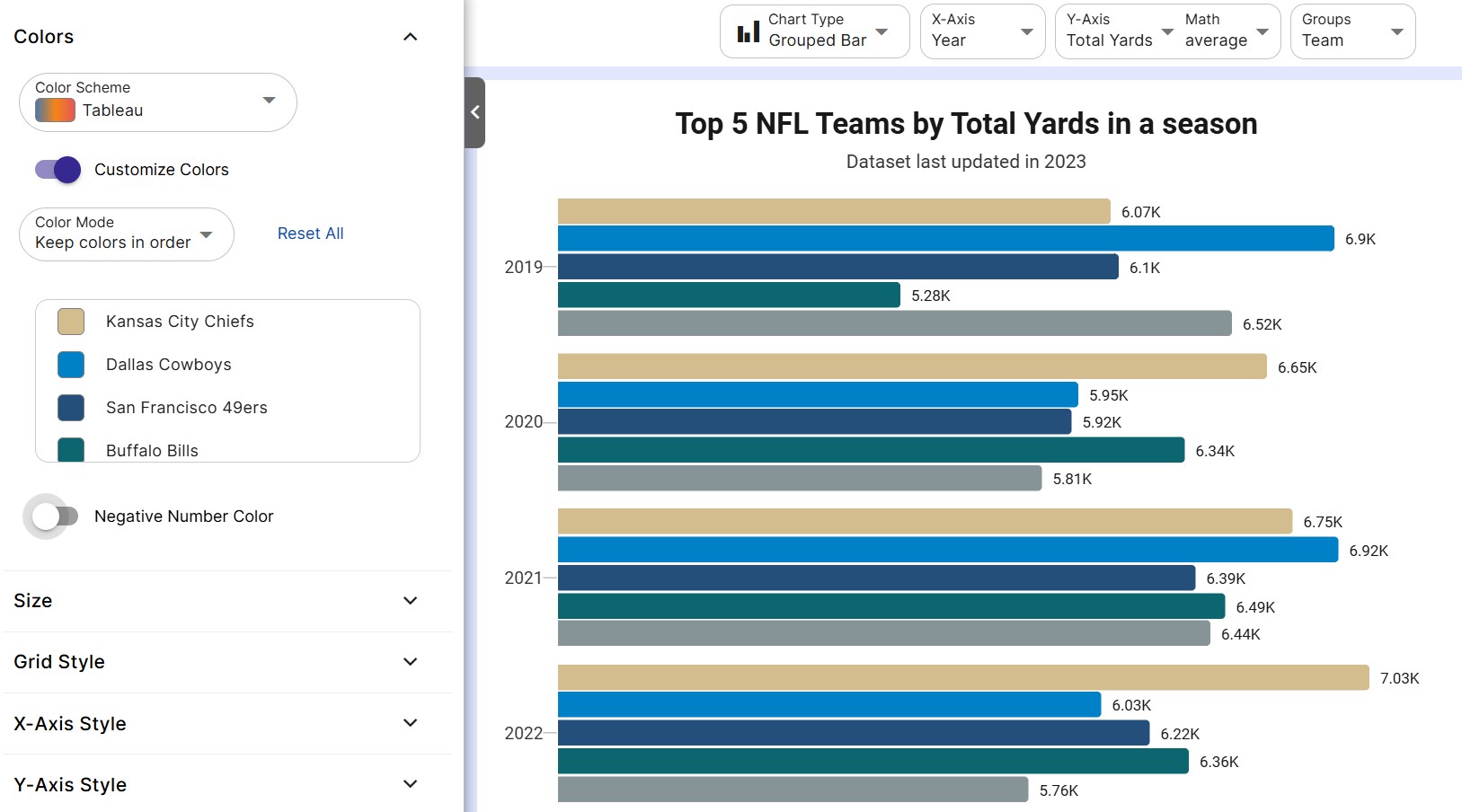
For charts that have multiple colors (multi line chart, pie chart, etc), use this section to customize which colors are assigned to different legend items.
-
Customize Colors Turn this toggle on to customize the colors shown in the chart. The colors will be prefilled with the chosen color scheme.
-
Color Mode Set to either save the colors in order, or assign a specific color to a specific label. This comes in handy when changing the columns plotted in the breakdown axis without losing your color selections.
-
Reset All Press the reset all button to revert back to the original color scheme.
-
Color Scroll Box All legend items will appear in this scroll box along with the color assigned to that item. To change an item’s color, click on it’s color square.
Negative Number Color
You can choose to show negative values in your chart in a different color. To show negative values in a different color, enable the Negative Number Color toggle, then select a color from the color box.
The default color for negative numbers is a shade of red.
Chart Width and Height
-
X-Axis Width A slider that sets the width of the x-axis. The value scale is in pixels, and the width can be set in 25 px increments.
-
Y-Axis Height A slider that sets the height of the y-axis. The value scale is in pixels, and the height can be set in 25 px increments.
-
Auto Size Large # Items When a dataset has a large number of items to plot (more than 20 items) in the X-Axis, this allows the X-Axis to stretch as long as it needs to in order to plot every item.
This setting is enabled by default.
Fonts
Use the Fonts card to set the font and font color for all the text in the chart, and optionally give the title, subtitle and axis titles their own font settings.
- Main Text Click the font button to pick the font used by all chart text. The menu opens with recommended fonts and any fonts you’ve used recently, and can search the full Google Fonts library.
- Font Color Set a font color applied to all chart text. Leave it unset to use InstaCharts’ built-in colors (a darker shade for the title, a lighter shade for the subtitle).
- Customize Text Toggle this on to override the font, size, bold, italic and color of the Title, Subtitle and Axis Titles independently of the main font. The title also gets its own line height option.
Adding a Custom Google Font
If the font you want isn’t in the list, open the font menu and click Add Google Font at the bottom.
Find a font on Google Fonts, open its “Get embed code” panel, and paste the
font’s stylesheet URL into the dialog (ex: https://fonts.googleapis.com/css2?family=Pacifico&display=swap).
The font is added to your list and applied to the chart immediately.
Grid Style
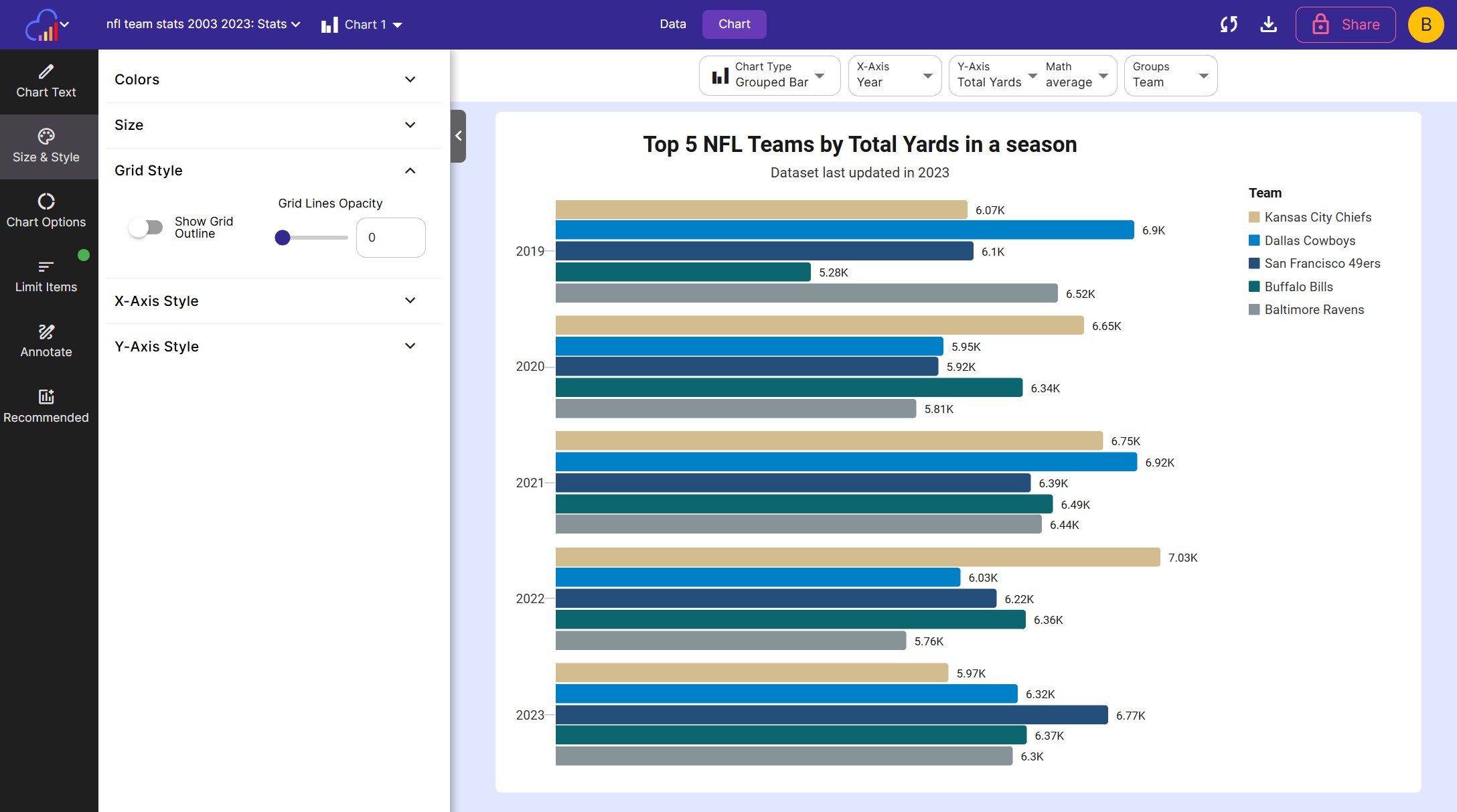
This card (labeled Plot Style in the left sidebar) controls the styling of the chart’s plot area and grid lines. These options don’t apply to pie charts.
- Show Plot Border Toggle this on to draw a border around the plot area, then choose its Border Color.
- Border Width and Border Radius Set the thickness and corner rounding of the plot border. Only shown when Show Plot Border is on.
- Plot Lines Opacity Choose a number from 0-100 to use as the opacity of the grid lines that connect to the Y-Axis. Set to 0 to turn off these lines.
- Plot Background Color Choose a background color that fills the plot area, behind the data. Leave it unset for a transparent plot background, or click Reset to clear a color you’ve set.
- Plot Shadow Toggle this on to add a drop shadow under the plot area.
X and Y-Axis Style
This card controls the styling of the X and Y-Axis, with separate tabs for each axis. These options don’t apply to pie charts.
Each tab contains the following options:
- Show Axis Use this toggle to turn on or off the entire axis
- Tick Mark Opacity Choose between a number from 0-100 to use as the opacity of the tick marks on this axis. Set to 0 to turn off the tick marks.
- Label Opacity Choose between a number from 0-100 to use as the opacity of the labels on this axis. Set to 0 to turn off the labels.
- Axis Line Opacity Choose between a number from 0-100 to use as the opacity of the axis line. Set to 0 to turn off the axis line.
- Title Opacity Choose between a number from 0-100 to use as the opacity of the axis title. Set to 0 to turn off the title.
Related
- Chart Options - sorting, axis min/max and chart-specific settings
- Labels - axis, series and data labels
- Chart Text - titles, legend and locale
- Dashboard Settings - the separate theme system for whole dashboards
- Workspace Chart Defaults - set a default theme, colors, fonts and style for new charts
- Chart Types - browse all available charts